
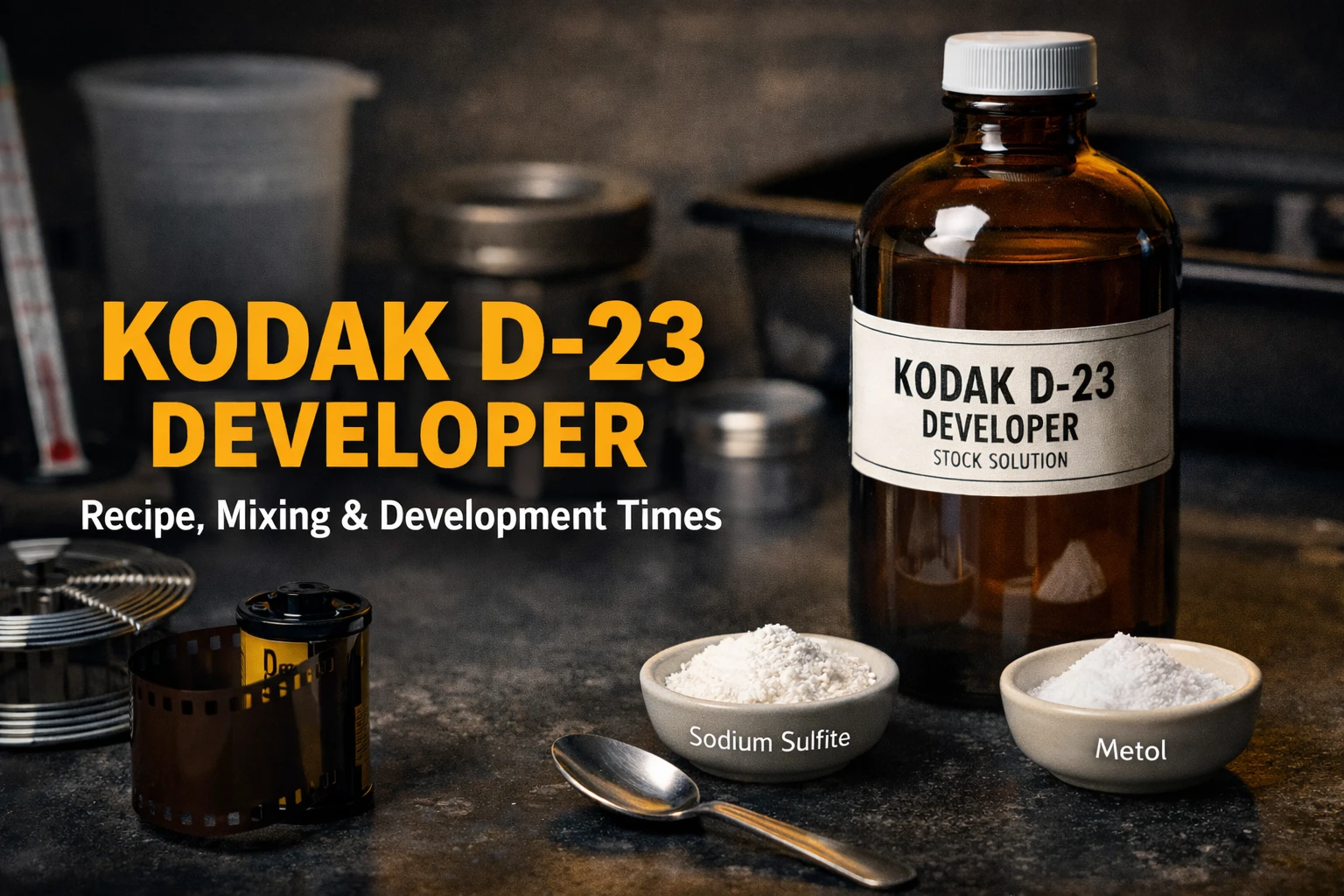
Kodak D-23 Developer: A Classic Two-Ingredient Film Developer
Kodak D-23 is one of the simplest black-and-white film developers ever created. Introduced by Kodak in the 1940s, it uses only two chemicals yet produces beautiful negatives with smooth tonal transitions and very fine grain. Because of its simplicity, reliability, and low cost, D-23 remains a favourite among photographers who enjoy mixing their own darkroom chemistry.
Despite its minimal formula, D-23 is capable of producing excellent negatives across a wide range of films and lighting conditions. It is especially appreciated for its smooth rendering of tones and its ability to control highlights in high-contrast scenes.
Below is a practical guide covering the ingredients, how to mix it, how to use it, and what results you can expect when developing film with D-23.
1. Ingredients
The classic Kodak D-23 formula contains just two chemicals plus water.
For one litre of stock solution you will need:
- Metol — 7.5 g
- Sodium sulfite (anhydrous) — 100 g
- Water — to make 1 litre
Metol is the developing agent. It reduces exposed silver halides in the film emulsion to metallic silver, creating the image during development.
Sodium sulfite acts primarily as a preservative and solvent. It protects the Metol from oxidation, helps maintain the working environment for development, and contributes to the fine-grain characteristics that D-23 is known for.
Because the formula is so simple, D-23 is easy and inexpensive to mix at home, making it a popular choice for photographers who want more control over their chemistry.
2. How to Mix It
Mixing D-23 is straightforward, but the order in which the chemicals are added is important to ensure everything dissolves properly.
Start by heating about 700–750 ml of water to roughly 50 °C. Distilled or de-ionised water is recommended to avoid contamination.
Add a small pinch of sodium sulfite to the warm water first. This helps prevent the Metol from oxidizing while it dissolves.
Next, slowly add the 7.5 g of Metol, stirring continuously until it is completely dissolved.
Once the Metol has dissolved, add the remaining 100 g of sodium sulfite and continue stirring until the solution becomes clear.
Finally, add water to bring the total volume up to 1 litre.
Allow the solution to cool to room temperature before storing it in a tightly sealed bottle. Stored properly, the stock solution keeps well for several months.
One important tip: if all of the sodium sulfite is added before the Metol has dissolved, the Metol may dissolve poorly or very slowly. Always dissolve the Metol first.
3. How to Use It (Dilutions)
D-23 can be used at several strengths depending on the type of result you want.
When used undiluted (stock), the developer produces smooth tones, very fine grain, and relatively low contrast. This is a good general-purpose method and preserves the full box speed of most films.
Diluting the developer 1+1 (one part stock developer and one part water) increases edge contrast slightly and can produce somewhat sharper results. Development times are longer, but many photographers prefer the look this dilution produces.
A more dilute working solution such as 1+3 introduces a compensating effect. This helps control highlights and can improve detail in high-contrast scenes. Because the developer is weaker at this dilution, development times are significantly longer and the effective film speed may drop slightly.
Diluted solutions are typically used as one-shot developers, meaning they are mixed fresh for each roll of film and discarded after use.
D-23 can also be used as the first bath in a two-bath development process, followed by an alkaline second bath. This technique can provide extremely consistent highlight control, though it is less commonly used in everyday processing.
4. Typical Development Times
Development times vary depending on film type, dilution, agitation, and personal preference, but the following are common starting points when working at 20 °C (68 °F) with normal tank agitation.
For Ilford FP4+ (ISO 125), development typically takes about 6 minutes in stock solution, around 8 minutes at 1+1, and roughly 18 minutes at 1+3.
For Ilford HP5+ (ISO 400), a typical starting point is about 7½ minutes in stock solution, approximately 13 minutes at 1+1, and around 20 minutes at 1+3.
For Kodak Tri-X 400, development usually runs about 7½ minutes in stock, roughly 12 to 13 minutes at 1+1, and approximately 18–20 minutes at 1+3.
These times assume standard agitation: about 30 seconds of continuous agitation at the start, followed by 5–10 seconds every minute.
As with any developer, these times should be considered starting points. Small adjustments may be needed depending on your equipment, agitation style, desired contrast, and scanning or printing workflow.
5. What to Expect
D-23 is often described as a soft-working developer, which means it produces gentle contrast and very smooth tonal transitions.
One of its most noticeable characteristics is fine grain. The high concentration of sodium sulfite acts as a grain solvent, helping produce smooth negatives that scan or print very well.
Another strength of D-23 is its excellent tonal range. Midtones tend to separate nicely, and highlights are controlled without becoming harsh.
The developer also has a mild compensating effect, particularly at higher dilutions. This helps preserve detail in bright areas while still maintaining shadow information.
Because D-23 is a solvent developer, images may appear slightly less sharp than those produced by high-acutance developers such as Rodinal. However, many photographers prefer the smoother, more classic rendering it produces.
Final Thoughts
Kodak D-23 demonstrates that a film developer does not need a complicated formula to produce excellent results. With only two chemicals, it delivers reliable performance, smooth tonal gradation, and fine grain across a wide range of black-and-white films.
For photographers interested in mixing their own chemistry or exploring classic darkroom formulas, D-23 is one of the simplest and most rewarding developers to try.
Its combination of simplicity, consistency, and beautiful tonal rendering is why this classic developer is still in use decades after it was first introduced.
